

Francis Barnett 1920s Models
344 cc. twin Villiers two-stroke at the 1926 Olympia Show:
In collaboration with the Villiers Engineering Company Messrs. Francis and Barnett are producing a novel 344 cc. twin two-stroke. This will have the two cylinders arranged vertically in a monobloc casting with the crankshaft lying along the centre line of the machine.
Motor Sports Magazine
Model 9 172-c.c. Super Sports 1927 (penned in 1949)
In September the two-stroke enthusiasts got a look-in, a Model 9 172-c.c. Super Sports Francis-Barnett being tested. This little motor-cycle came equipped with really efficient leg-shields, which called forth high praise, yet which could be removed in three minutes when required. An adequate metal toolbox was carried beneath the tank, but the petrol pipe rather impeded withdrawal of the simple tool-roll.
The engine seized-up twice in the early stages, fusing over the rings on the induction side, but when fully run-in, and using “Mixtrol” as well as ordinary lubricant in the fuel, no further trouble was experienced. Indeed, mit leg-shields, lamps and 11-stone rider, the Francis-Barnett lapped Brooklands at over 50 m.p.h., upholding the maker’s speed claim of 55 m.p.h. And at a grass-track meeting 22 miles were covered all-out in second and bottom gears, the machine whining the 250-c.c. class and finishing fourth out of 14 in a 9-mile “Grand Prix” which attracted o.h.v. “500s.”
The handling on wet grass was excellent, and the gear-ratios pleasantly close, while ratio-changes could be effected by hand or foot as the mood dictated. The engine pulled hard at low speeds, so that middle-gear sufficed for main or secondary-road hills. Both brakes worked on a dummy belt-rim on the rear wheel and both were extremely powerful and smooth, adhesion being aided by large balloon tyres and correct weight distribution.
The handle brake operated via Bowden cable, easily adjusted, but adjustment of the foot-brake, by three different holes to accommodate the brake-rod, was badly blanked by the flywheel-magneto and the frame. The plug, too, was a brute to remove. On the credit side, the Francis-Barnett earned full marks for comfort, riding position, excellent carburetter levers, and good steering, with or without damper. Fuel consumption was excellent and the frame very strong, surviving “long jumps,” being run into from behind by a car and crashing with sufficient violence to break the rider’s collarbone. Remarkable as it seems in 1949, this 1927 machine cost only £38 10s., new.
Motor Sport Magazine
172cc Super Sports Villiers 1928
A firm which has won a fine reputation for up-to-date design is the Francis Barnett factory. Of chief interest to the sporting owner is the 172 c.c. Super Sports with Villiers engine. This engine has twin ports with sweeping exhaust pipes ending in twin silencers. Expanding brakes, Terry saddle, and new type forks with steering damper render the machine more controllable than ever. A neat handle has been fitted to the rear mudguard, and grease gun lubrication to cycle parts is standard. Dunlop wired on tyres of 25 x 3 in. size are fitted. Altogether the machine is very alluring at £36.
Motor Sport Magazine
Empire Model No. 12 247cc Villiers at The Olympia Show, 1929
The most notable alteration in Francis-Barnetts for 1929 is the fitment of saddle tanks throughout the range.
In all, there are five models, two 147 c.c., two 172 c.c. and one 247 c.c., the latter being an altogether new machine. It will come as a surprise to many to note that the twin-cylinder Pullman model is not included in the 1929 range, but this is due to the fact that it has been temporarily withdrawn from the market pending detail improvements.
The new machine, which is known as the Empire Model No. 12, has a 247 c.c. Villiers two-stroke engine. It incorporates the usual well-known Francis-Barnett features and has a very complete equipment.
The engine is inclined at an angle of 26 degrees from the vertical, and an Albion 3-speed gear-box, Villiers twolever carburettor and Renold chains are standardised. This machine obviously represents excellent value at its price of …
Motor Sport Magazine
1929 “200” Model
The ideal utility mount is here illustrated. The Francis-Barnett “200” model retains all the advantages of lightness and handiness of our other models, while the increased engine capacity and low compression ratio make for easy starting, even two-stroking at slow speeds, increased pulling power, and the period between decarbonisation is lengthened. For the long day’s run, for severe gradients, or for dense traffic, this model is strongly recommended. It affords ease of control, flexibility, docility, and comparative silence. Electric Lighting, Automatic Lubrication, Balloon Tyres and Terry Saddle.
PRICE £33
50 m.p.h. 100 m.p.g.
Motor Cycling, June 19th, 1929
Olympia Show 1920


Francis-Barnett. (Stand 34.)
-
2¾ h.p.; 70×76 mm. (292 c.c); single-cylinder four-stroke; side-by-side valves; splash lubrication; B. and B. carburetter, chain-driven magneto; two-speed Sturmey-Archer gear; chain and belt drive; 26 x 2¼ in. tyres. Price £89 5s.
Francis and Barnett. Ltd., Lower Ford Street, Coventry.
The Francis-Barnett lightweights are among the prettiest in the Show, and one interesting result of the 1921 taxation scheme is that the makers are careful to state the exact weight of all their models. With empty tanks and without lamps or tools, the weights range from 152 lb. for the single-speed two-stroke, to 195 lb. for the de luxe model, fitted with J. A. P. engine.
The handsome aspect of the machines on this stand may be ascribed to an excellent quality of finish and to tasteful colouring, the black tank being heavily lined in scarlet and lettered in gold. Moreover, this tank is of the “saddle” type, giving a flush finish to the top. The designer understands that quite seventy-five per cent, of the people who ride lightweights like to have a clutch and kick starter, which he accordingly fits to all his variably-geared models. Metal-rimmed footboards covered with linoleum are standard, and on the de luxe, model a pair of efficient legshields is included. With these extras the machine is catalogued at £105.
A similar machine to the four-stroke is the two-stroke model, which is engined with a 2½ h.p. Villiers engine, and sells at £370 7s. single gear, and £80 17s. with two-speed gear.
The Motor Cycle December 2nd, 1920.
The 2¾ h.p. Francis Barnett

SPECIFICATION
| ENGINE: 2¾ h.p. single cylinder | MAGNETO: C.A.V. | WHEELS: 26×2¼ in. Dunlop tyres |
| J.A.P. (70 x 76 mm. = 292 cc.). | GEAR BOX: Sturmey-Archer two- | FORKS: Brampton Biflex. |
| LUBRICATION : Hand pump. | speed and kick-starter. | FRAME: Rigid. |
| CARBURETTER: Brown and | TRANSMISSION: Coventry chain | WEIGHT: 188 lb. |
| Barlow. | and Dunlop belt. | PRICE: £S5. Tax 30/- |
ALTHOUGH the 3½ h.p. single is still perhaps the most popular type of solo mount in this country, it is being run a close second by the 2¾ h.p. machines.
During the last year or two this type has indeed proved itself to be both speedy and thoroughly reliable, as witness the excellent performance made by the tiny J. A. P. engine in the T.T. and recent 500 Miles Race ; these successes, coupled with the economical running of the type, will undoubtedly continue to gain for it the favour of many riders.
Glancing over the features of a dozen well-known lightweights, the similarity of the specification is striking, although to the average eye the machines look quite different. The 2¾ h.p. J. A. P. engine, Sturmey-Archer two-speed gear box, chain-cum-belt drive, wheel sizes, etc., convey the idea that such machines must be exactly similar in performance, and true, it is often difficult, when testing a variety of makes, to find any outstanding characteristic which would make one lean toward any particular one.
It was with this problem in mind that the writer recently took a standard 2¾ h.p. Francis-Barnett for a test run over the Cotswold Hills one very hot Sunday afternoon. This little mount, which is a typical example of the sturdy British lightweight, is familiar to most readers, so that detailed specification is unnecessary – the chief characteristics being the saddle tank, short leg shields, and easily adjustable rear brake.
Leaving the garage at noon, the main road was followed to Broadway via Stratford, prior to trying the machine on the well-known trials hills of Saintbury, Willersey, and Rising Sun. The Francis-Barnett behaved very well, and it was not long before one realised that its real charm lay in its general handiness and controllability – the riding position, distribution of weight, and wheelbase length all combining to give the rider a sense of perfect security and comfort.
One becomes accustomed to any type of machine, but there are some mounts upon which one immediately feels ” at home.” The Francis- Barnett is one of them.
Turning off the main road at the familiar stone cross, we were soon humming up Saintbury, bottom gear being engaged about half-way up, the engine pulling well thereafter with plenty in hand. Willersey, the corresponding descent, provided an excellent opportunity for testing the brakes, and it was found possible to bring the machine to a dead stop on the steepest portion, the rear brake being exceedingly powerful.
On the way to Cheltenham a stop was made to run down the Rising Sun Hill (Gambles Lane), and attempt to reclimb it, back to the main road again, over the steep and loose gradient, a clean ascent being made without any fuss.
In spite of the fine weather very little traffic was encountered between Stratford and Cheltenham onboth outward and return journeys,and with a clear road it was found possible to ride mile after mile without touching the bars ; this is, of course, possible on other types, but how often does one find when testing the steering that the machine pulls to one side, and in some cases starts to wobble immediately the bars are released. This form of riding should not ordinarily be indulged in for obvious reasons, but it served to prove that the machine in question steers perfectly without the slightest wobble even when passing over a bad section of the road. The wide and smooth tank forms a very comfortable grip for the rider’s knees.
It is after using such machines as this, after the heavier type, that one appreciates the vast strides made in lightweights in recent years.
Summing up, the Francis-Barnett is a well-made, speedy, and thoroughly reliable little solo mount, but undoubtedly that which appeals to one most is its perfect controllability, a quality bringing it into the front rank of British lightweights.
Sources: The Motorcycle
Francis Barnett Models for 1923


The 1922 Olympia Show.
FRANCIS-BARNETT. (81.)
Refined Mounts in 350 c.c. Class.
2½ H.P. MODEL.
70×75 mm. (293 c.c.); single cyl. four-stroke; side valves; hand pump lubrication; B. and B. carb.; chain-driven mag.; 3-sp, gear; clutch and kick-starter; chain drive; 26×2¼in. tyres. Price £64.
FRANCIS-BARNETT, LTD., Lower Ford Street, Coventry.
In the main both the sporting and the touring models of the 293 c.c. Francis-Barnett are unaltered from the machines that were on the road last year. The touring machine in particular is a good, solid-looking and reliable type, well equipped, and not expensive. Considerable care has been taken to make it possible to remove the rear wheel with the minimum of trouble. The second model is almost identical in lines with its predecessor, but is of 346 c.c. and costs £72 as a solo machine, or £85 with a neat sidecar.
Another model with the 345 c.c. engine is a sports machine painted a very nice and serviceable grey. Naturally, it has the super-sports J.A.P. engine, and incidentally has been extremely successful in various important competitions this year.
On the Francis-Barnetts the tool kit is carried behind the seat tube, where it is in many ways better protected and less subject to vibration.
Greater clearance has been provided between the mudguard and the wheel, and the chain guards, which are substantial, are secured in position by two bolts only, so that they can be detached quite easily.
Olympia Show 1922
The Motorcycle, November 30th, 1922. Page 836
Francis Barnett 1925 Models


1½. HP. TWO-STROKE MODEL
Unequalled for Reliability, Utility, Economy,
THE illustration below shows the Francis-Barnett with Electric Lighting, Leg Shields and Carrier. This is the most popular equipment, and those who use their machines in all weathers find the leg shields invaluable. The Carrier is light, but strong, and will safely bear a load of one hundred pounds.
The Francis-Barnett was awarded Two Gold Medals in the A.C.U. 1,000 miles Stock Trial, and a Gold Medal and Silver Medal in the Scottish Six Days’ Trial, 1924. Belt driven machines were used in the former event and Chain driven in the latter.
Chain Drive, Two or Three Speeds.
TO meet the demand for a Light Two-Stroke machine with Chain Drive, we have pleasure in submitting the Model illustrated. This machine has been subiected to most exhaustive tests on the road, and is offered with complete confidence in its efficiency and stability.
The wheels are fitted with knock-out spindles, for quick removal, and the rear chain is steadied and adjusted by means of a jockey sprocket, mounted on an eccentric to ensure speedy operation. 2¼ in. Dunlop Cord Tyres are fitted.
SPECIFICATION.
ENGINE. 147 c.c. Villiers, 55 m/m bore × 62 m/m stroke, with flywheel magneto.
CARBURETTER. Mills.
GEAR. Albion; Two Speed Ratios : 6¾x11. Three-Speed Ratios : 6¾ x 10 x 16.
TRANSMISSION. Renold Chains.
LUBRICATION. Petroil System; One part oil to 16 parts petrol.
FRAME. Registered Design. Fully Triangulated, combining lightness with great strength. Weldless Steel Tubing throughout.
TANK. Capacity 1½ gallons.
TYRES. 24″ × 2¼” Dunlop Cord.
BRAKES. -Right foot and right hand, acting on rear wheel.
HANDLEBAR. Adjustable for position, rigidly attached to head.
MUDGUARDS. 4¾” wide.
STAND.-_Tubular.
FOOTRESTS. Rubber-covered.
SADDLE. Large, comfortable Pan saddle, well sprung.
WHEELS. –24″, with Knock-out Spindles for quick removal.
EQUIPMENT. Tool-bag, good capacity, with necessary spanners. Inflator fitted.
FINISH. Finished throughout in best quality black enamel.
Weight of Standard Chain Drive Model, Three Speed Gear- -138 Ibs.
1¾ H.P. TWO-STROKE SPORTS MODEL

172 c.c. Chain Drive. Three Speeds.
THE 1¾ H.P. Sports Model is intended for those who require a machine of somewhat higher power than the 147 c.c. Model. The engine has Double Exhaust Ports and the silencer is furnished with a long extension pipe. Sight Drip Feed lubrication is employed and the tank capacity is increased. The handle-bar position is modified to render the machine more suitable for high speeds and for competition work. When the engine has been run in this model is capable of a speed of fifty miles an hour.
Awarded Gold Medal and Silver Medal in the Scottish Six Days’ Trial, 1924.
Francis Barnett Pullman 1927-28
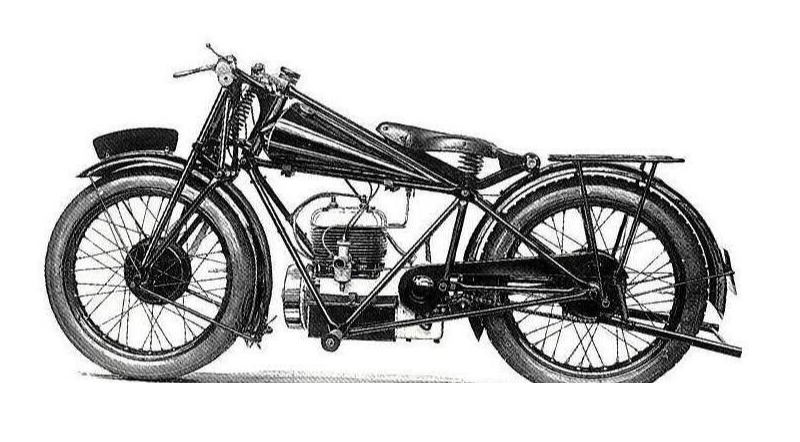
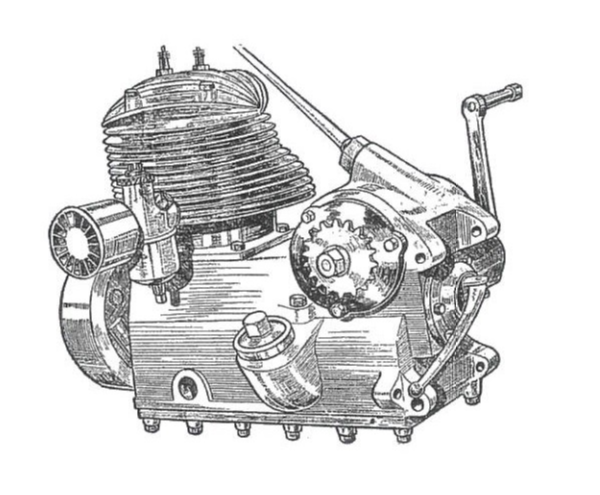
1927-28 Francis-Barnett Model 10 Pullman 350 cc
In the 1920s Villiers engines were known for their speed and reliability – both Francis-Barnett and Monet-Goyon established several world records in 1927 with the 175cc singles.
Due to the ingenious design of their frames, Francis Barnett had become established as one of the largest manufacturers of light motorcycles, and was one of Villiers most important customers. This is perhaps why at the 1926 London show, Francis-Barnett presented the Model 10 Pullman with the first Villiers twin-cylinder engine. Of 344cc (57 x 67 mm, the same dimensions as the 175cc single) it had aluminum pistons, a 180° crankshaft mounted on three plain bronze bearings and was of unit-construction with a three-speed gearbox and multi-disc clutch in an oil bath. Lubrication was via an ingenious automatic delivery system using crankcase pressure to feed the roller bearings from the oil reservoir.
Considered a luxury touring model, it was mildly tuned for smooth performance rather than having a goal of achieving a high speed. The unusual layout had the cylinders placed one behind the other. The aluminum barrel was secured to the cast-iron crankcase by five screws, and the ignition drive was located in front of the engine. The Villiers carburettor was on the left, while a cast aluminum collector dealt with the exhaust gas on the opposite side.
Lauded in the motorcycle press for its smooth running, the Pullman was however excessively heavy (at 127 kg it could achieve only 95 km/h) and quite expensive – it was dearer than a Norton 500 OHV or a Velocette 350 OHC – so the model failed to attract a market and was retired from the catalog after a just two years.
Monet-Goyon presented their BL 350 at the Paris Salon in 1927 with the same engine, and it appeared in their 1929 catalog. MT of Austria also released a version (basically a badge-engineered Sun), as did Mondiale of Belgium and NSH from Germany. Villiers abandoned production of the engine in 1929, so all of these models were very short-lived.
A machine named Warren appeared in 1941 with a Villiers 344cc engine – probably a one-off special.
A fine example of the Francis-Barnett Model 10 has been displayed at the Sammy Miller Museum.