
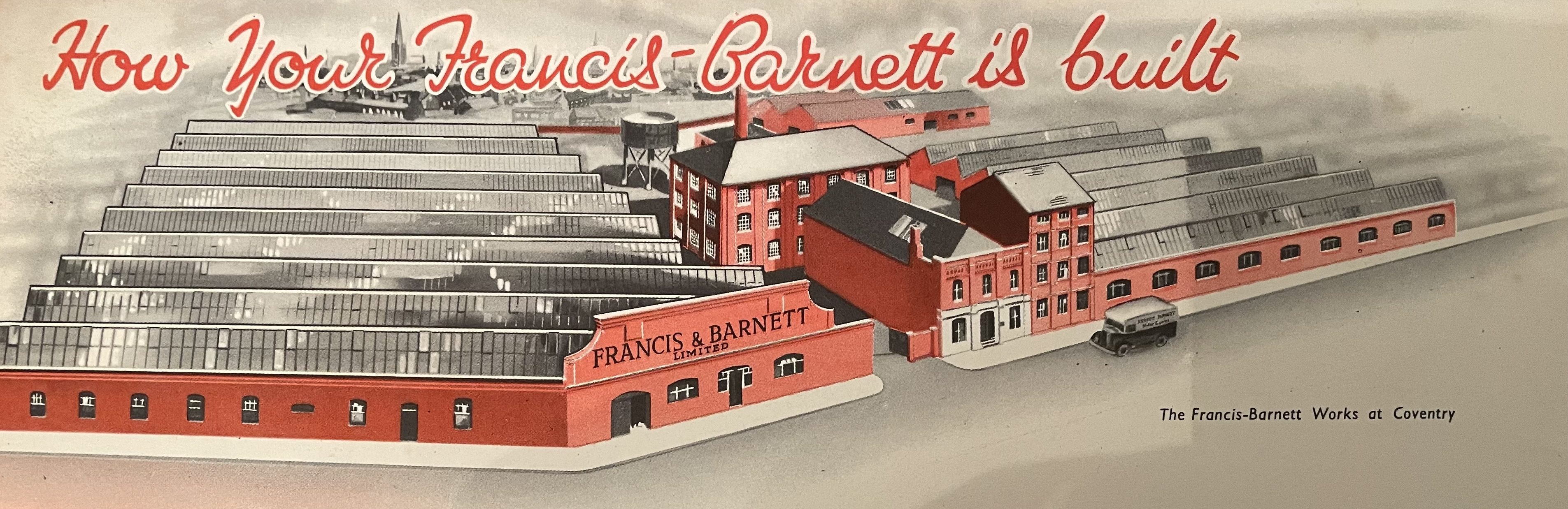
A Brief History of Francis-Barnett
Gordon Francis, son of Graham Francis of Lea Francis fame, combined his talents with Arthur Barnett in 1919 to create a new lightweight motorcycle for which they felt there would be a great demand. In the post-war era economical transport was at a premium and the new motorcycle was developed not only with the motorcycle enthusiasts in mind, but also for citizens who needed reasonably priced personal transport. This is not to say that the early motorcycles were cheap to purchase, but neither was any form of transport immediately after the war. Gordon Francis and Arthur Barnett were, in fact, related by marriage. They started their business in Coventry in the Midlands and by coincidence the first Francis-Barnett motorcycle was constructed in the same workshop as the first english motorcycle, the Bayliss-Thomas Excelsior.
The first Barnett was a 292cc side valve J.A.P. engined machine with a two speed Sturmey Archer gearbox. Its red and black petrol tank was a very pleasing sight to a prospective purchaser. The only hesitation they might have had was the price of £84.The price continued to be a problem with the costs of production. Gordon Francis came up with a revolutionary plan giving the buyer a cheaper but better machine. In the army he had observed with alarm the frequency of motorcycle frame fractures. He was able to try out his ideas for overcoming this problem when back in the Francis-Barnett workshop. In 1923 he evolved a system of six pairs of straight tubes and one pair specially formed which made up the framework of the motorcycle. In appearance the frame below the tank formed an inverted triangle; the triangular shaped tank was held by a similarly formed set of tubes.The framework from saddle to rear wheel hub and down to the footrest formed yet another triangle.
The wheels of the new Francis-Barnett were on spindles, these could be easily removed. The machine was driven by a 147ccVilliers two-stroke engine with flywheel magneto, Albion two-speed gearbox and belt final drive. Light in weight, easy to strip and reassemble, it was also light on the pocket and cost only £25. The reason for the low price was that lower cost were incurred in the manufacture of the parts required. Everybody was satisfied with the new little Francis-Barnett which was claimed to be “built like a bridge” because of its constructional principles. The frame was in fact guaranteed against breakage forever. It was not the only motorcycle coming out of the factory in 1923 as there were also 250cc and 350cc machines with sidecars available.
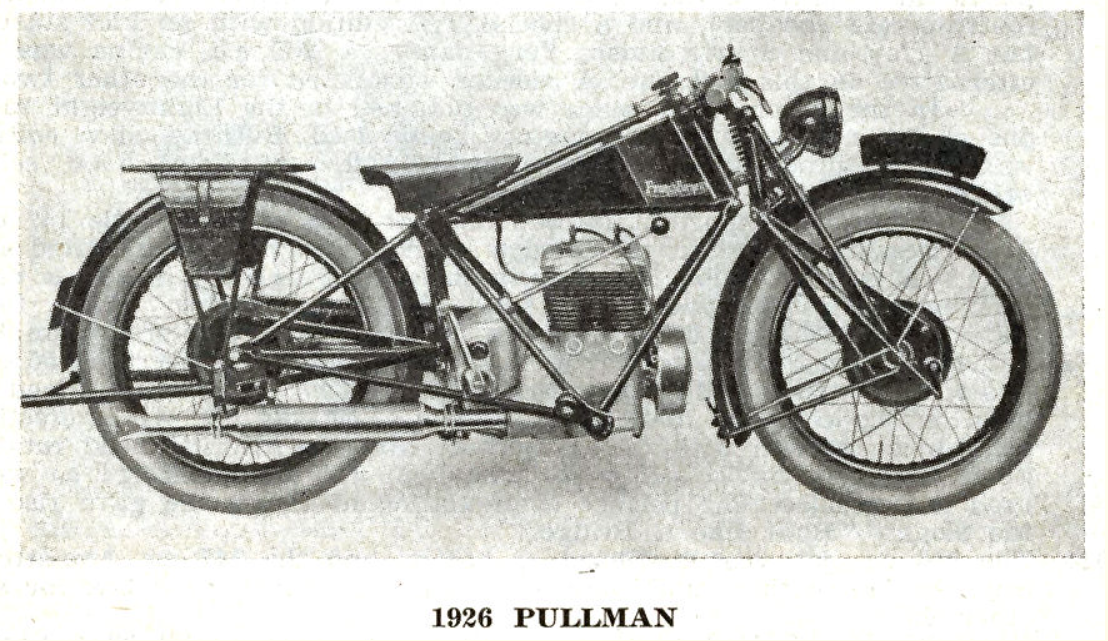
The next impact on the motorcycling scene made by Francis-Barnett was the Pullman, a 344cc vertical in-line machine with a two-stroke Villiers engine.
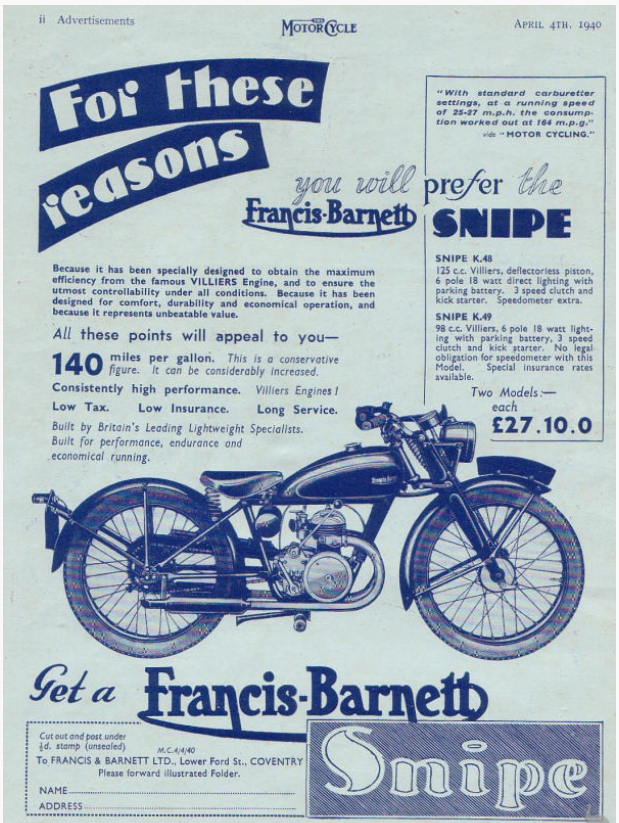
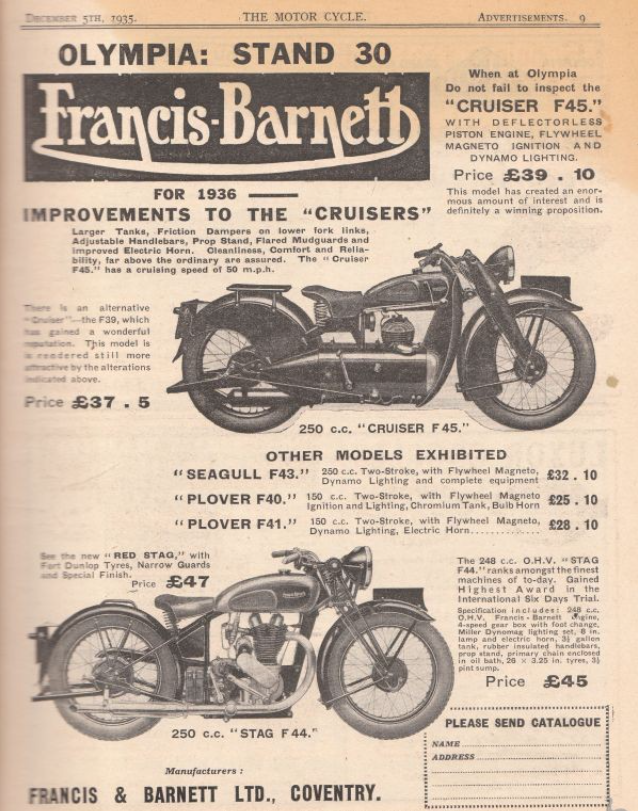
This became available to the public in 1928 and in next two years Francis-Barnett followed the fashion which called for cream coloured machines. The 250cc Cruiser, brought out in 1933, typified the Francis-Barnett attitude to the traveller who did not want to dress up to keep clean on his or her motorcycle. This model was virtually totally enclosed. Production continued until the Second World War, as did the manufacture of the Stag model, a 248cc Blackburn engined machine with overhead valves, first introduced in 1935. The other events of the pre-war period were the manufacture of a 125cc model called the “Snipe” and an even smaller machine, an autocycle named”Powerbike” with a 98cc engine. Both of these machines made a return immediately after the end of World War 2.
These models and other two-stroke lightweights were to be the order of the day. They continued in production under the name Francis-Barnett even when the Company amalgamated with Associated Motor Cycles Ltd, the London based Matchless concern in 1947.Models like the “Plover”,”Falcon”and “Cruiser” sold well in the fifties and many a worker rode to work on a FB in those far off days,on a machine that was recognised as a quality lightweight. The colour had changed to green (known as “Arden Green”) from the predominantly black finish of the earlier days. A full range of factory designed accessories was also available to ensure the rider’s comfort and convenience. The off road rider was also well catered for with a range of competition models that acquitted themselves well. For a short period the tried and tested Villiers engine was abandoned in favour of AMC’s own Piatti designed unit; these were not wholly successful and the Company reverted back to Villiers. The market place was changing however and production was transferred to the Birmingham based James Company,(also part of the AMC Group) in the early 1960’s. The factory in Lower Ford Street,Coventry was closed, some workers transferring to James. All individuality disappeared,both James and FB models now being virtually identical apart from the badges and colour. This continued until 1966 when the whole AMC empire ceased to operate. All signs of the factory in Coventry have now disappeared under the ring road but the Owner’s Club thrives with the intention of “keeping alive the living legend”. Many cherished examples of models bearing the famous trademark appear at the Club’s Annual Rally which takes place each year in August.
John Baker / John Goodberry.
Francis Barnett History Continued
Lower Ford Street, Coventry
Francis-Barnett of Coventry were producers of motorcycles from 1920 to 1966.
- Affectionately known as the Fanny B, Francis-Barnett specialized in making economical and lightweight roadsters. They moved into the former Excelsior works in Coventry when that company moved to Birmingham.
- The company was founded in 1919, by Gordon Francis (whose father, Graham Francis, was co-founder of Lea-Francis) and Arthur Barnett of A. Barnett and Co, his father-in-law, at Lower Ford Street, Coventry.
- The new Francis-Barnett was effectively an Invicta from A. Barnett and Co, with a different tank transfer. This continued until Arthur Barnett adopted the bolted-tube frame design.
- The Invicta continued with the 269cc two-stroke Villiers engine, which was then joined by 346cc and 678cc sv JAP, plus 499cc Abingdon engines. The largest had chain drive.
- 1923 The range had reduced to 247cc Villiers, and 292cc and 346cc four-stroke engines.
- 1924 There were four-strokes only.
- 1925 The four-strokes were joined by a 147cc Aza two-stoke. It was to be their final year of production.
- 1920 The first model was produced using a 292cc JAP engine driving a two-speed gearbox by a chain within an aluminium case and belt final-drive – it also had foot-boards with toe guards, and sprung forks.
- 1921 Another model appeared, using the 269cc Villiers engine.
- 1922 In came a model with a 346cc JAP engine and all-chain drive.1923 The well-known ‘built-like-a-bridge’ frame concept was first introduced, having been devised by Gordon Francis. Cheap to make and easy to assemble, it had seven pairs of tubes, all but one of them straight, that bolted up to form a triangular frame. This also allowed the bikes to be taken apart for shipping and the company advertised that it could be re-assembled in 20 minutes (a fact that was recorded on film). It used a 147cc Villiers engine which resulted in a very cheap and popular machine. The frame was, in fact, guaranteed against breakage forever.1924-1926 Various models were added to the range including those for Sports and Touring. The JAP engine capacities were of 147cc, 172cc, 175cc and 346cc. The 175cc model was sold as the Aza.1927 Only two-stroke models were made during that year, plus the limited production Pullman with its unusual design whereby the cylinders and crank-shaft were set along the frame to drive the three-speed gearbox, built in-unit, with a worm drive to a shaft carrying the final-drive sprocket. The Pullman had a 344cc vertical-twin Villiers engine, made specially for Francis-Barnett, but production was limited.1928 The range remained the same.1929 The Pullman had gone, but 196cc and 247cc models were added.
1930s The new decade brought new models and, in particular, the Cruiser. It had a new frame design and an enclosed engine, gearbox and rear chain, using panels that left just the cylinder in view. For the rest of the decade, the firm produced mainly two-strokes. These had names such as Merlin, Kestrel, Lapwing and Plover.
1935 They offered a four-stroke fitted with a 247cc Blackburne engine that had crossed push-rods. It was listed for three years as the Stag.
1940 Following World War II, the company produced only two models – the Powerbike and the Merlin.
1947 The company became part of the AMC group but this had no real effect for quite some time.
1949 The range expanded and over the next few years all the motorcycles went over to telescopic forks.
1952 Pivoted-fork rear suspension first appeared, as did the firm’s first competition models.
1954 The Cruiser name was revived and used for a 224cc model, which had a frame incorporating pressed members, but without the enclosure.
1957 The company was forced (together with James) to fit the new 249cc AMC engine into the Cruiser. The design of this engine was not as reliable as the Villiers and its troubled performance affected its success. Gradually all Villiers engines used on Francis-Barnett models were replaced by AMC.
1959 A second Cruiser appeared that had the entire rear-end fully enclosed, even the pillion rests folding flush, and leg-shields as standard.
1961 Employs 260 persons. Part of AMC.
1961 Lightweight motor cycle manufacturers, makers of “Francis-Barnett” and “Fanbar” motor cycles. 260 employees.
1962 Villiers engines were once again used in some models, and in particular on the Cruiser Twin and the newly-styled Fulmar with a spine frame, leading-link forks, pressed-steel bodywork and the 149cc AMC engine.
1964 The same AMC engine went into a single-tube spine frame to produce a restyled Plover.
1966 The Plover was replaced by a simple, basic model. The parent company had major financial problems and this brought the end of both Francis-Barnett and James in the October of that year.
POTTED HISTORY OF THE FRANCIS-BARNETT
Messrs. Francis & Barnett, of Lower Ford Street, Coventry, are, by Vintage standards, a modem make. The firm was founded shortly after the 1914/18 war, when Captain Gordon Francis, a son of Graham Francis, who with R. H. Lea had founded the old Lea-Francis concern in 1895, started up with his father-in-law, Arthur Barnett, who had been a director of the old Singer Company and more recently the Invicta concern, who made a few lightweight motorcycles as an adjunct to their pedal cycles. They obtained factory space in Lower Ford Street, which had been devoted to munitions during the war, but had originally been part of the Hillman works, and later had housed Bayliss-Thomas when they produced the first Excelsior. (The fact that I have mentioned six firms so far may give you some idea what Harold Karslake was up against when chronicling the industry). Here they started to produce a straightforward motor-cycle of good design and performance. A lightweight which was not a scaled down version of something bigger, which would form a stepping stone to something better. They had no crank ideas, no vast racing programme (though the name appeared regularly in every branch of the sport), but sold the kind of bike the ordinary sort of chap could afford to buy, and having bought, could have the sort of fun or get the sort of service he expected from it.
Their history, as successful manufacturers, would be of interest for that reason alone, but they have produced some extraordinarily interesting machines betimes. Yes, and modelled their entire range round them if they sold, or dropped them just as quickly if they did not. Built cheap by correlation of design and production, rather than made cheap by reason of material or workmanship, The industry would do well to take a lesson from their Vintage years in the testing time ahead.
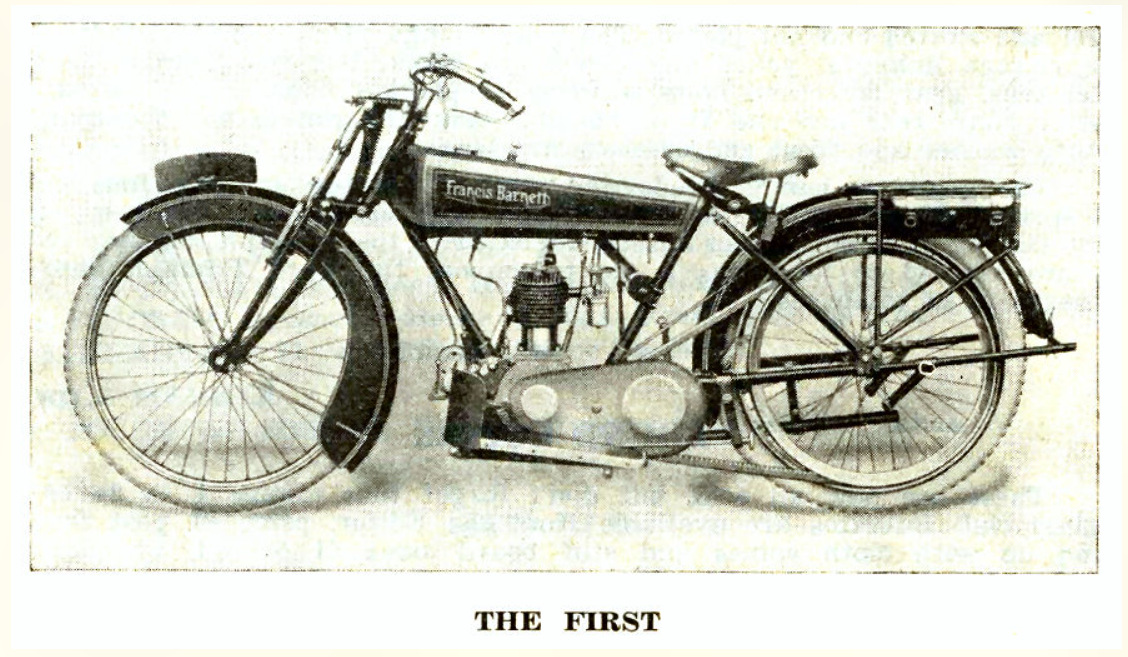
1920 The first Francis Barnett was announced in March of this year, and had a conventional diamond-type frame fitted with the then current 293 c.c. (70 x 76) side valve J.A.P. engine (optimistically rated as 22 h.p., to rank with the 350 c.c. class) and driving via a Sturmey-Archer two-speed gear-box, with the primary chain fully enclosed in an aluminium case, and belt drive to the rear wheel. A pleasant semi-saddle type tank, finished in red with black panels, covered the straight sloping top tube, with the control cables led from the bars inside its rounded nose. The detail work was good, such features as a hand adjuster for the rear brake being noteworthy. Accessories were C.A.V. magneto, B. & B. carburettor, Brampton Biflex forks (sprung top links), and so on. Weight, 195 lbs. Price, a reasonable post-war 84 guineas.
1921 For the Show at the end of the previous year, the J.A.P. engined job was continued, and the firm started their long association with Villiers, with a h.p. two-stroke, either single geared or with the two-speed box plus clutch. The single geared job weighed but 152 lbs. Tanks were black, lined with red, this year.
In April of 1921 a,n overhead valve edition of the J.A.P. engined job was produced, though it did not go into production. It had exposed push rods operating valves set vertically in the head, and boasted an Amac carburettor, Webb internal expanding front brake, and a central stand operated by a hand lever. The firm claimed that so well was the machine balanced on the stand that the weight of an overcoat on either end would raise the other end. “The Motor Cycle” road tested the job to do 50, which was quite something; and naively remarked that the flexible tubing of the straight-through exhaust deadened the note, though it had not the resonance of copper tubing. Happy days.
1922 An additional model with the 350 c.c. side valve J.A.P. engine, driving via a three-speed box with gear lever mounted on it. Saved a lot of trouble when adjusting one’s primary chain. Accessories by B. & B., and M.L., footrests in place of footboards, all black finish, and a total weight of 190 lbs. There was a cheaper edition of the two-stroke as well, with a non-saddle type tank slung beneath the top tube.
In the Isle of Man, R. W. Loughton rode one of the J.A.P. engined jobs, fitted with a 246 c.c. side-valve T.T. engine, and finished in quite a creditable tenth place in the Lightweight at over 40 m.p.h.
1923 Quite an important year. As far back as July the previous year the customers had started asking for chain drive on the 293 c.c. job and the wretched firm had given in. Now they dropped all belt drive editions, and organised a new two-piece chain guard. You could have the 346 c.c. job in three forms: Standard with footboards and legshields, Sports with footrests (£2 cheaper), and a special T.T. edition with no kick starter, but a grey and mauve finish. Very pansy. A 250 c.c. engine was an alternative on this last one. A sidecar was listed for the other two.
In the Island, 21st place was obtained in the Lightweight race, one of the new o.h.v. J.A.P. engines being used. But the o.h.v, edition was not in production again, the firm’s first (and only) o.h.v, seller being the 250 c.c. “Stag” of 1935.
The really important introduction for 1923 was the little 147 c.c. Villiers engined job with the Gordon Francis designed, triangulated and bolted-up, straight tube frame. Introduced in February, it had a very simple specification, with Mills single lever carburettor, Albion two-speed gear with belt drive, C-spring forks (hence both brakes on the belt rim), 24×2 tyres, petroil lubrication to the three-port type 55×62 two-stroke engine, and a weight of 100 lbs. Two fitters were timed to build one up complete in 20 minutes. The price was £27. An interesting point in connection with the frame was that the steering head rotated about a fixed spindle, using the same cup-and-cone bearings as were used in the hubs. The perfect triangulation of the frame gave rise to the slogan “Built like a Bridge.”
1924 The 346 c.c. job was continued as before, and the 147 c.c. two-stroke could be had with a clutch for £1 extra, or a three-speed box for another £2.
The last T.T. entry was T. G. Meeten’s in this year’s Ultra-Lightweight race, with a 175 c.c. Blackburne engine in the triangulated frame, but where you usually find the gear-box, the latter being mounted in front. The odd little job finished 6th, too.
A month before the T.T. a Francis Barnett appeared in the Grand Prix de Lyons with a 172 c.c. Villiers engine in the triangulated frame, and chain drive via a three-speed box. Following its success in the Scottish Six Days we started to holler, and it was officially listed in August, the frame being slightly altered to take the chain drive. The 57 x 67 engine had a fixed iron head, two exhaust ports, and drip-feed lubrication from an oil compartment in the wedge-shaped fuel tank. There was a neat jockey-sprocket on the underside of the rear chain to take up slack, and you could have a Senspray carburettor. The Scottish jobs, and the first of the production jobs, had additional steel strips from the steering head to the front of the crankcase. Windy about whether it was the Tay Bridge they were built like, we said. 1925 Only the two-strokes, the 147 costing £27 and the 172 £38. There were agents handling only F.-B. too, rather like the Raleigh set-up. You could get a rubber block to go in the C-spring of the forks, and a proprietary steering damper, but you still could not have a front brake. Not with those forks, 1926 At the Show at the end of the previous year, there was a Super Sports edition of the 172, with detachable aluminium head (iron piston), and you could have “Oxford Bags” exhausts, too – sort of trousers-shaped expansion chambers directly on the ports.
In place of the Villiers engine, a 175 c.c. side-valve Aza (made by J.A.P.) was proposed, but, though it was at the Show, it did not go into production, which means to me that we did not want to buy it enough.
A heavier edition of the same frame, widened to 16″ at the bottom to take a 346 c.c. J.A.P. engine, was listed again, with parallel action front forks which allowed an internal expanding front brake by Webb to be fitted.
During the year a slim young man blushing to the name of J. J. Hall broke 11 world’s records on an F.-B. fitted with a little Aza two-stroke of 124 c.c. (50.5×62), a size specially made for the German market, whereon it had taxation concessions. It was reputed to have an aluminium piston and transfer via a hollow gudgeon pin. But it did 40 for three hours, and later the same year a 98 c.c. edition of the same engine propelled the same “you should see him now” to another 15 records in its class, about 4 m.p.h, slower than the 124.
1927 Belt drive as an alternative for the 147 was finally dropped, and the Super Sports edition of the 172 had (and probably needed) a steering damper. Also curved exhausts to rearward silencers, and a pressure oiling system utilising crankcase compression piped to the oil compartment of the wedge shaped fuel tank, also an aluminium piston.
Something of a sensation was caused by the new 350, for it was to be fitted with a vertical in-line twin two-stroke, by Villiers, made exclusively for F.-B. The triangulated frame was retained, with a conical rounded-front tank, and internal expanding brakes front and rear. The 344 c.c. (57×67) engine was built on car lines, and with handlebar control for the flywheel magneto at last. But the Pullman, as it was called, was not yet ready for production.
The same year, J. W. Moxon, riding a 172, was a member of the British team in the International Six Days Trial, which was quite something, and did not happen just because they liked his face.
1928 The Pullman finally went into production this year, with a straightsided tank rather like the 172, and internal expanding brakes. The 172 itself had link action forks which allowed internal expanding brakes, too – yes, a brake on the front wheel at last. The 147 had a long plated exhaust in place of that little cylindrical silencer across the front of the crankcase, and a new gear-box by Albion with the layshaft behind the mainshaft, and the lever on the box.
1929 Saddle tanks for all models, black with orange panels we were told. But we wanted cream panels like the other maker’s new jobs, and you know what happened when we hollered for chain drive in ’23, for the 172 engine in ’24, etc. The Pullman was withdrawn for “further development work” and the frame used for the new Empire model, with the 247 c.c. Villiers engine with detachable head, sloping forward parallel with the front down tubes. The new saddle tank (with cream panels) was recessed to take a special broad-nosed saddle, and the 172 had a separate oil tank for the pressurised system, under the saddle. It and the 250 had tankside “gate” gear changes mounted up forward. A listed extra was a twist-grip. During the year a 196 c.c. edition of the fixed-head 172 c.c. model was introduced.
1930 Direct lighting had been standardised throughout the range for a while, and one could now have a Westinghouse rectifier with it. Spring-up stands on all models, too. A new edition of the 196 c.c. engine with detachable aluminium head, and performance in keeping with a larger edition of the popular Super Sports 172, made its bow. The tankside gear lever was lengthened and lay alongside the tank, working up and down in the gate, while the saddle was recessed rather more deeply into the tank (with cream panels) on all models, and one could have the wheels in a special finish (to match the tank panels).
1931 Yes, they still make a motor-cycle. A.M.C. own a controlling interest, but how else can one ensure continuity of management policy with death duties at their present rate?
Invicta Motorcycles


Invicta motorcycles were lightweights designed by Arthur Barnett.
He constructed the Invicta at his works at West Orchard, Coventry, commencing in 1913. The machines were fitted with 269cc Villiers two-stroke engines with petroil lubrication and a chain-driven magneto. Two models were offered; both had Druid forks. One was belt driven, the other had a two-speed Jardine gear and chain-cum-belt drive.
Engine – 2½ h.p. two-stroke, 269 c.c.
Iqnition – U.H. magneto, chain-driven.
Carburetter – Senspray.
Change Speed – Single-speed, 5½ to 1. Two-speed. Jardine gear, 5½ and 8¾ to 1.
Transmission – Belt or chain and belt.
Dimensions – Height of saddle from ground, 26in. Ground clearance 4in. Wheelbase, 48½in.
Lubrication – Oil mixed with petrol.
Other Features – Druid forks.
Price – Single-speed, 28 guineas. – Two-speed, 35 guineas.A Barnett and Co., West Orchard, Coventry.
In 1919, he joined with Gordon Francis (whose father, Graham Francis, was co-founder of Lea Francis) at Lower Ford Street, Coventry to form Francis Barnett.
Invicta marque continued until 1923.